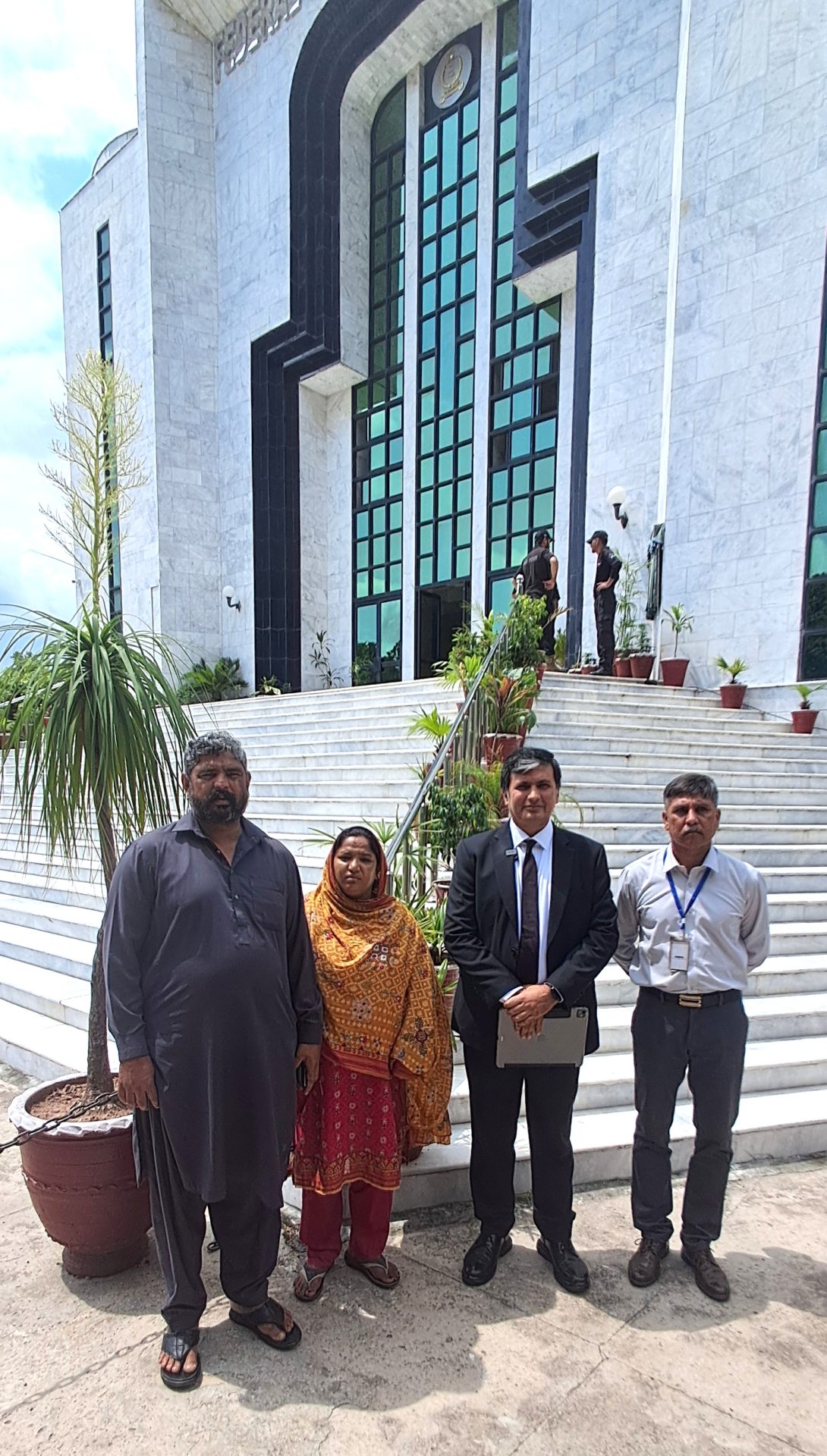
Maria Shahbaz’s parents Shahbaz Masih and Erum Shahbaz with attorney Saqib Jillani and rights activist Safdar Chaudhry (R) at Federal Constitutional Court building. (Christian Daily International-Morning Star News)
ISLAMABAD (Christian Daily International–Morning Star News) – Pakistan’s Federal Constitutional Court (FCC) on Friday (July 24) agreed to revisit its controversial ruling that upheld the marriage of a Muslim to a 13-year-old Christian girl allegedly abducted, forcibly converted to Islam and married against her will.
A two-member bench comprising Justice Syed Hassan Azhar Rizvi and Justice Aamer Farooq heard a review petition filed by Shahbaz Masih, father of Maria Shahbaz. Supreme Court Advocate Muhammad Saqib Jillani represented the petitioner.
Opening the proceedings, Farooq emphasized that the case was not about any particular religion but concerned the constitutional rights of all Pakistani citizens.
“This issue is not linked to any specific faith,” he observed, assuring the parties that the court remained the guardian of the fundamental rights of every citizen regardless of religious affiliation.
Rizvi, who was part of the bench that issued the court’s Feb. 3 ruling validating the marriage, referred to the record of previous proceedings before the magistrate, sessions court, high court and the FCC.
“The girl consistently stated before every forum that she had married of her own free will,” he noted. “At no point did she indicate that those statements had been made under duress.”
The judge also expressed broader concern about cases involving underage girls who are groomed or lured away from their homes, saying the issue transcended religious divisions and required a societal response.
“We have observed that when girls leave home and marry men of their choice, they are often either killed in the name of honor or rejected by their families, leaving them with nowhere to return,” Rizvi said. “Non-governmental organizations should focus their efforts on addressing this issue.”
He then asked the petitioner’s counsel what the legal status should be of marriages involving children. Jillani replied that any marriage involving a minor should be declared void, adding that this formed the central basis of the review petition.
The lawyer argued that the FCC’s previous judgment had relied on legal precedents that were no longer authoritative following a recent ruling by the Federal Shariat Court (FSC) in the Ali Azhar v. Province of Sindh case. Drawing the bench’s attention to that judgment, Jillani said the FSC had clarified that Islamic law requires not only physical puberty but also mental maturity as an essential condition for marriage.
“The impugned judgment relied on precedents that have since been superseded by the FSC’s decision,” he submitted. “The Federal Shariat Court rejected the continued reliance on outdated jurisprudence suggesting that child marriages remain legally valid despite statutory prohibitions. Such reasoning is inconsistent with recent constitutional and Islamic legal developments and undermines child protection laws.”
Jillani further argued that both Islamic jurisprudence and Pakistani law restrict minors from entering into legally binding contracts.
“Marriage is a contract in Islam,” he told the court. “A minor therefore cannot legally enter into a marriage of his or her own choice. Likewise, any statements recorded by Maria before various courts regarding her age or marriage have no legal value because she was a minor.”
Following the hearing, the FCC issued notices to the alleged husband, Shehryar Ahmad, the Attorney General for Pakistan, and the Advocate General for Punjab Province, scheduling the matter for a date to be fixed after the Supreme Court’s summer recess.
Speaking to reporters afterwards, Jillani welcomed the court’s decision, saying the issuance of notices reflected the importance attached to the case.
“The Attorney General has been directed to personally assist the court regarding the implications of the earlier judgment for fundamental constitutional rights,” he said. “This demonstrates that the court recognizes both the sensitivity and significance of the issues involved.”
Two additional review petitions challenging the FCC’s Feb. 3 judgment have also been filed by the Karachi-based Legal Aid Society and the Lahore-based advocacy group Christians’ True Spirit (CTS). Those petitions are expected to be heard alongside Shahbaz Masih’s petition at the next hearing.
Welcoming the FCC’s decision to admit the review petition for hearing, Tehmina Arora, director of advocacy for Asia of legal advocacy group ADF International, told Christian Daily International-Morning Star News that Maria’s case is a crucial moment in the movement to protect young girls from the crisis of forced marriage in Pakistan.
“We hope that the court will re-examine the evidence that was previously relied upon by the lower courts, deliver justice, and establish a precedent that protects other vulnerable girls from these grave abuses,” said Arora, whose group is supporting the family’s legal struggle.
In an exclusive interview with Christian Daily International-Morning Star News on July 21, Jillani said the FCC had committed multiple legal errors by recognizing a marriage that violated Pakistan’s child marriage laws despite official government records confirming that Maria was under the legal age for marriage.
“The court ignored compelling evidence that the marriage was unlawful because Maria was underage according to her official birth records,” said Jillani, who has litigated several prominent human rights cases in Pakistan.
Although the FCC acknowledged that the Child Marriage Restraint Act, 1929, applies equally to Muslims and non-Muslims, he argued that it failed to give effect to the Federal Shariat Court’s authoritative interpretation of Islamic law.
“The FSC made it clear that marriage in Islam is not determined solely by biological puberty or the capacity for sexual relations,” Jillani said. “Marriage establishes legal rights and responsibilities that require mental maturity, psychological stability and economic capacity.”
He noted that the FSC distinguished between the Islamic concepts of Balugh (physical puberty) and Rushd (mental maturity), observing that classical Islamic jurists have long treated them as separate concepts.
“Mental maturity frequently develops later than physical maturity because it depends upon intellectual, emotional and educational development,” Jillani said, adding that the FSC cited classical Islamic scholarship, including the opinion of Imam Abu Hanifa, who regarded 25 years as a reasonable benchmark for attaining full Rushd.
He also challenged the FCC’s conclusion that while the Child Marriage Restraint Act criminalizes child marriage, it does not render such marriages legally void.
The petition further disputes the FCC’s assessment of Maria’s age. In its earlier judgment, the court questioned the reliability of records issued by the National Database and Registration Authority (NADRA) after noting that Shahbaz Masih had reportedly provided a different age when filing the First Information Report following his daughter’s disappearance.
Jillani argued that the discrepancy should not outweigh official government records.
“Any inconsistency could easily have resulted from Shahbaz Masih’s emotional distress while reporting his daughter’s abduction or from an error by the police officer recording the complaint,” he said. “Such a discrepancy cannot override official documentation establishing that Maria was underage.”
He also rejected the FCC’s suggestion that Maria’s birth certificate and NADRA records were unreliable because they had been issued several years after her birth.
“There was no evidentiary basis for the court to question the authenticity of these official documents,” he said. “This was not a trial in which the petitioner bore the burden of proving their genuineness.”
Maria’s case has become one of Pakistan’s most closely watched religious freedom cases, attracting international scrutiny from human rights organizations and European lawmakers concerned about the abduction, forced conversion and marriage of underage girls from religious minority communities.
On July 9, the European Parliament adopted a resolution highlighting Maria’s case and urging Pakistan to establish a national mechanism for receiving complaints from families of abducted or forcibly converted girls belonging to religious minority communities.
Maria was abducted in July 2025 by Muhammad Ahmad, who allegedly forced her to convert to Islam and compelled her to marry him, according to her family. On Feb. 3, the FCC ruled that the marriage was valid and ordered that she remain in Ahmad’s custody.
International advocacy organizations continue to rank Pakistan among the world’s most difficult countries for Christians. In its 2026 World Watch List, Open Doors ranked Pakistan eighth among the 50 countries where Christians face the most severe persecution, citing systemic discrimination, mob violence, forced conversions, bonded labor and gender-based abuses. The organization also said weak law enforcement and widespread impunity have enabled perpetrators of anti-Christian violence to escape accountability.
If you would like to help persecuted Christians, visit https://morningstarnews.org/resources/aid-agencies/ for a list of organizations that can orient you on how to get involved.
If you or your organization would like to help enable Morning Star News to continue raising awareness of persecuted Christians worldwide with original-content reporting, please consider collaborating at https://morningstarnews.org/donate/?
###
© 2026 Christian Daily International-Morning Star News. Articles/photos may be reprinted with credit to Christian Daily International-Morning Star News. https://morningstarnews.org
Tweet: https://twitter.com/morningstarnewz/
Facebook: https://www.facebook.com/MorningStarNews
Morning Star News is a 501(c)(3) non-profit corporation that relies solely on contributions to offer original news reports of persecuted Christians. By providing reliable news on the suffering church, Morning Star News’ mission is to empower those in the free world to help and to encourage persecuted Christians that they are not forgotten or alone. For free subscription, contact [email protected]; to make tax-deductible donations, visit https://morningstarnews.org/donate/? or send check to Morning Star News, 34281 Doheny Park Rd., # 7022, Capistrano Beach, CA 92624, USA.

-

- Maria Shahbaz’s parents Shahbaz Masih and Erum Shahbaz with attorney Saqib Jillani and rights activist Safdar Chaudhry (R) at Federal Constitutional Court building. (Christian Daily International-Morning Star News)
Speak Your Mind